


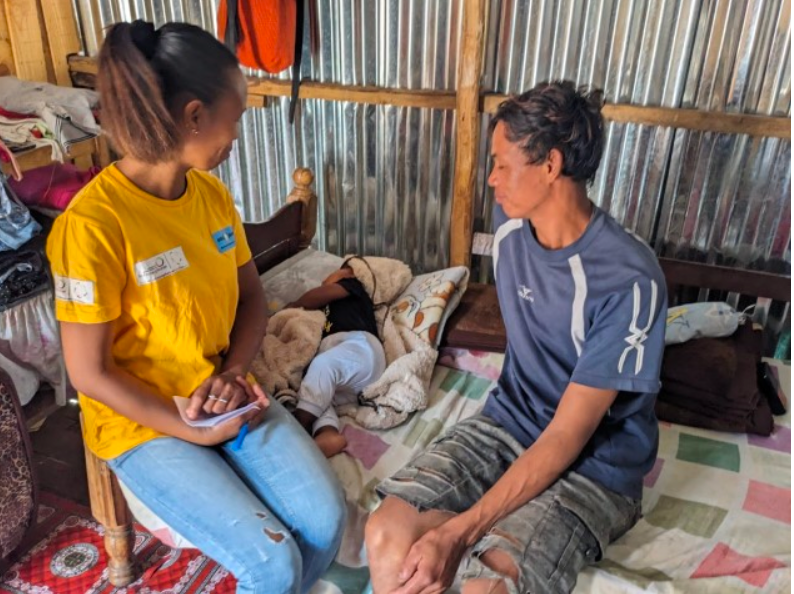
Capacity building and incubation of partners
ATIA’s primary objective is to improve the living conditions of very vulnerable people. To achieve this, it carries out field activities through local partners whose creation, development, skills growth, viability and, ultimately, autonomy it fosters. The aim is for these local partner associations, created in the course of the programme, to be “the support base of the programme, and later its relay” (Inter Aide charter). In urban areas, slums are often characterised by instability, large migration flows and a fragmented social fabric. Sustaining services therefore depends on setting up teams of professionals employed locally.
To support partners, and to design and implement activities with them, ATIA recruits expatriate staff (“programme managers” or “technical advisors”) based directly in the areas of intervention and assigned 100% of their time to one partner. From the headquarters and through regular field missions, the head of sector and the administrative and financial manager in charge of each programme also support local partners in carrying out activities: they train local teams (in technical, operational, organisational, managerial, legal, accounting and financial matters, etc.) and ensure the quality of activities and the proper use of funds.
Once a partner has achieved a solid technical level, as well as organisational and financial viability, ATIA gradually withdraws. The local association then becomes autonomous in both implementing and financing its activities. This approach allows activities to continue, in line with the same key principles of intervention, after ATIA has moved on to another area.
Autonomy cannot be decreed. It requires demanding work to identify, train and stabilise local management and teams, a process that ATIA carries out in close collaboration with its partners. This is a challenge: it means attracting and retaining skilled people who are willing to work for a salary that is often lower than market rates, in basic working conditions. Such profiles are scarce, particularly for management positions.
Autonomy therefore takes significant time, which varies depending on the context and the programme. Development is a long-term process, and the path to autonomy generally takes at least 15 years, and often longer. Since 2012, ATIA has brought 8 local structures to autonomy, initially created by the NGO Inter Aide and then taken over by ATIA, notably in India (microfinance and health insurance), the Philippines (microfinance and social) and Madagascar (integrated microfinance with social and health components).
Learn more about the history of the creation, development and autonomy of our partners.
Location of partners
ATIA supports local social organisations that implement the programmes in the countries of intervention. Each marker shows the partner’s area of intervention: see the legend below.
Key — click to filter
Access to healthcare
Quality education
Socio-economic inclusion
Madagascar
9 partners — 7 cities
Mahajanga: MAMPITA (social microfinance), RAITRATIA (tuberculosis and capacity building). Vatromandry: RAITRATIA (tuberculosis and capacity building). Antananarivo: AFAFI (health mutual), MISSONGA (capacity building), KOZAMA (education), TOHANA and KETRIK’ASA (vocational training and job placement), KOLOAINA (family support), RAITRATIA (tuberculosis and capacity building). Antsirabe: RAITRATIA (tuberculosis and capacity building), KOZAMA (education), KOLOAINA (family support). Fianarantsoa: AFAFI (health mutual). Manakara: SAHI (social microfinance). Antsohihy: no partner attached to date.
India
4 partners — 3 cities
Jaipur: LSS, ALERT and KGST (family support). Mumbai: LSS, ALERT and KGST (family support), LSS and NSVK (tuberculosis). Bhiwandi: LSS, ALERT and KGST (family support), LSS and NSVK (tuberculosis).
No partner matches this filter.
As at 1 January 2025. A partner may run several programmes and work in several cities: RAITRATIA covers Antananarivo, Antsirabe, Vatomandry and Mahajanga, KOZAMA works in Antananarivo and Antsirabe, and in Mumbai LSS runs both a family support programme and a tuberculosis control programme.