


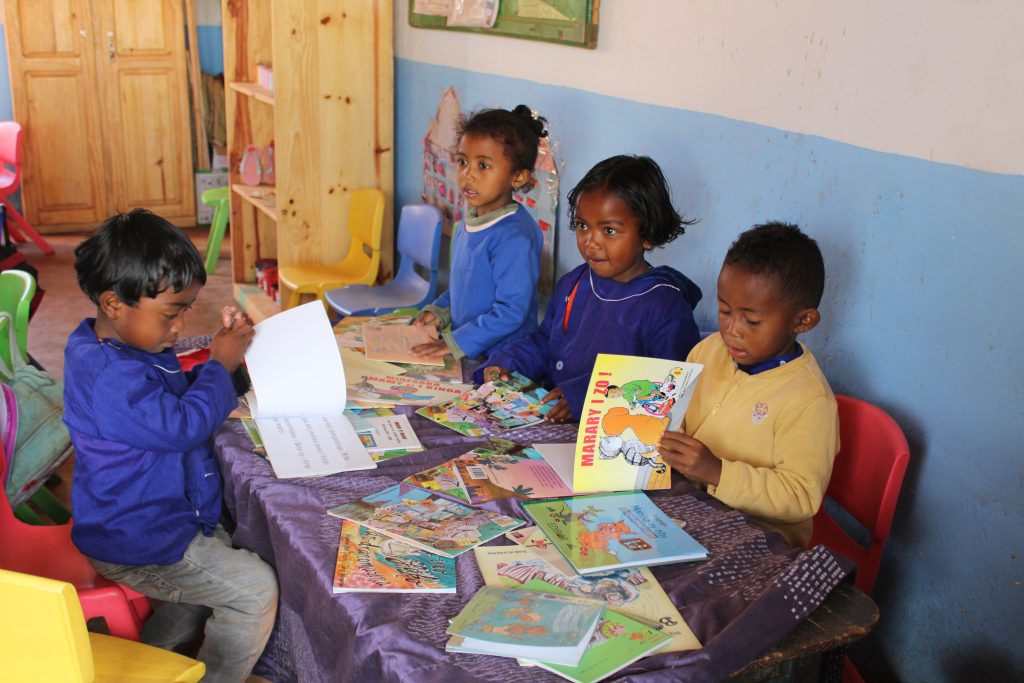
Programme run by our partner KOZAMA in Madagascar
In Madagascar, “this project had a demonstrable transformative effect within the Ministry of National Education. The overall environment of state education improved through quality educational provision, despite the State’s limited means. With KOZAMA’s expertise, state pre-primary classes are assured of quality tools, tested at full scale. Monitoring activities were visibly revitalised at school-district level. Pre-primary educators trained by KOZAMA have also become important resource people who lead teacher development days. In short, this project demonstrated the complementarity between KOZAMA and the Ministry for the benefit of state schools, and above all for early childhood and primary education.”
(From the evaluation of the 2019-2022 project under European Union funding — March 2023)
Teacher training
In Madagascar, only 15% of children attend preschool, even though not attending preschool significantly increases the risk of repeating a year and dropping out in the first years of primary school. This situation is made worse by a lack of teacher training: nearly 80% of teachers have received no initial training, which severely limits the quality of teaching in public schools.
To address these two issues, ATIA and its local partner KOZAMA support the creation and improvement of preschool classes within public primary schools in deprived neighbourhoods, while training the educators and teachers who run them. Each school receives structured support over three years: a first year focused on setting up rituals and basic teaching practices, a second year of consolidation, then a third year of tapering support leading to the educator’s independence. The classes are equipped with suitable furniture, teaching kits and learning workbooks designed by KOZAMA, and schools receive light renovation work where needed.
For primary school teachers, this continuing training scheme is built each year around an intensive training of several days before the start of the school year, focused on teaching the core subjects (Malagasy, mathematics, French) and on play-based teaching, followed by individual support throughout the year with classroom observations and preparation sessions. Specific training is also offered to school heads, to strengthen their ability to supervise and monitor teaching practices in their schools.
This model is based on a principle of sustainability: preschool educators and primary school teachers continue to be paid within the public education system, which guarantees that the gains last once the support ends. This scheme, carried out in close collaboration with the Ministry of National Education and the school districts, contributes to a lasting improvement in the quality of teaching, from early childhood through the whole of primary school.
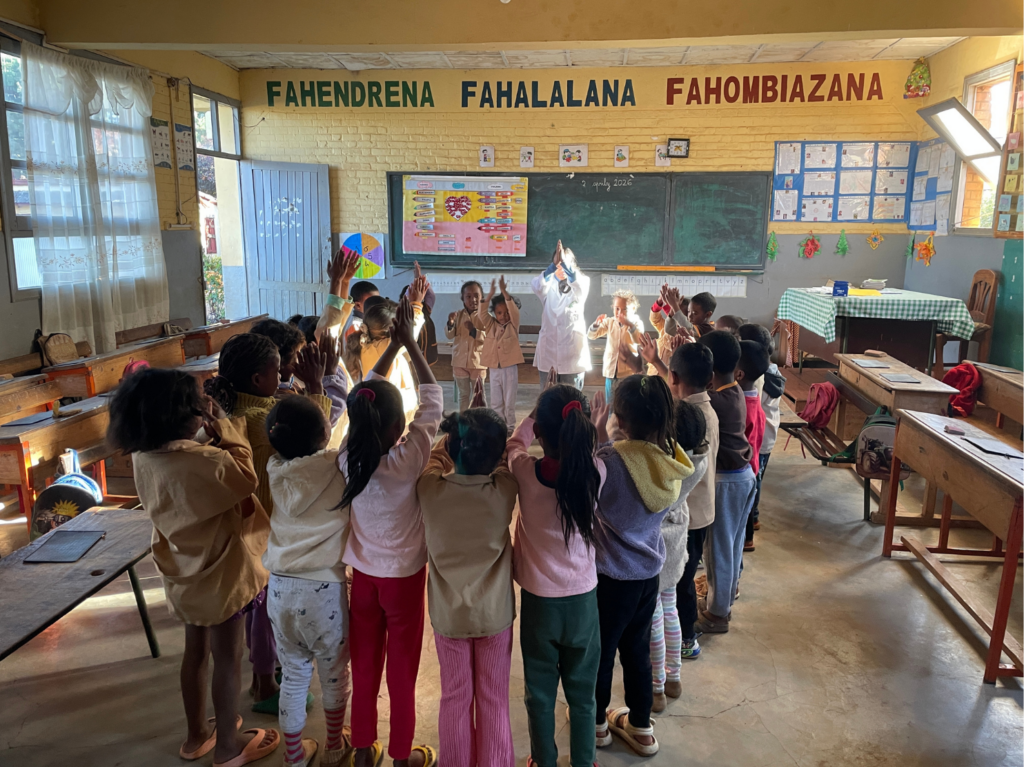
School tutoring
In deprived neighbourhoods of Antananarivo and Antsirabe, many pupils in the first years of primary school (Years 1 to 3) have difficulties learning to read, write and do mathematics, with a significant risk of dropping out.
ATIA and KOZAMA offer tutoring sessions in small groups, adapted to each area of intervention. In Antananarivo, the sessions are led by KOZAMA educators in partner public schools, combining revision of basic concepts, written exercises and reading time. In Antsirabe, remedial classes are provided by volunteer teachers or members of parent committees, trained and supported by KOZAMA’s teaching teams.
Pupils are selected according to objective criteria (school results, repetition rates) and followed over several months, which makes it possible to consolidate their basic skills in a lasting way and to reduce the risk of dropping out of school from the first years of primary school.
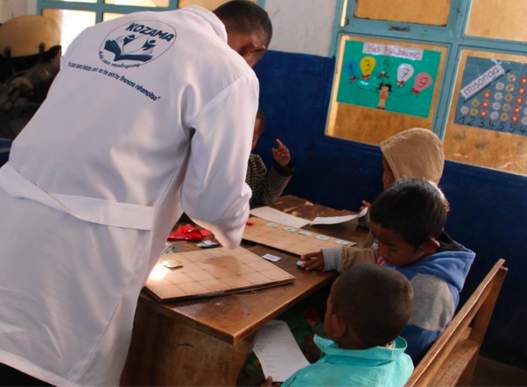
Parent-child workshops
To prevent developmental delays in very young children, ATIA and KOZAMA run early learning workshops for children aged 0 to 2 and their parents, in several community areas of Antananarivo.
These weekly workshops offer simple, playful activities (games, massage, conversation) that strengthen the bond and communication between parents and children, while making parents aware of the importance of early stimulation for their child’s development. They are also a space for exchange and parenting support, contributing to significant progress in children’s psychomotor development and in the quality of the parent-child relationship.
LEARN MORE
about the latest results in figures of the programme
about the location of the programme in Madagascar