


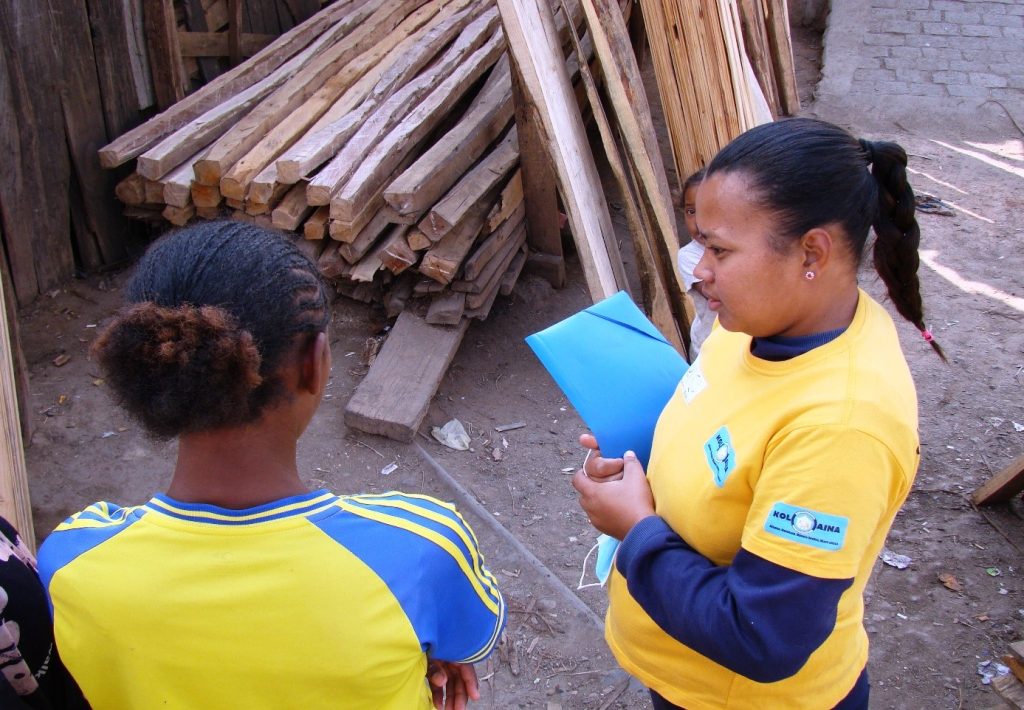
Programmes run by our partner KOLOAINA in Madagascar, and by LSS, KGST and ALERT in India
Psychosocial support (India and Madagascar)
Psychosocial support is based on a personalised, holistic approach aimed at improving the living conditions of the families visited.
Support is provided through weekly home visits over a period of six months, during which social workers listen to, advise and guide families, especially women, to boost their self-esteem and confidence, and help them access various services according to their needs.
These objectives may include improving health conditions, access to education, obtaining administrative documents, managing household finances, or strengthening women’s mobility and independence within their communities.
The results show a significant improvement in addressing families’ social and economic problems, through an approach that promotes self-reliance rather than dependency.
Once all the households in an area have been visited and supported (provided they meet our criteria and have requested support), the partners identify a new area and roll out their activities there. In addition to home visits, social drop-in sessions are open to all members of the community, whether or not they receive home support, offering information and referral to existing social and administrative services. Group activities also reinforce this individual support: workshops bringing mothers and their children together to strengthen parenting practices, discussion groups where women, teenage girls and sometimes mothers-in-law can talk about topics such as self-esteem, equality between girls and boys or the prevention of violence, as well as maternal and child health sessions organised with local health centres.
Support for victims of domestic violence (Madagascar and India)
In the face of intra-family violence, ATIA and its local partners offer specific support to women who are victims of domestic violence. Specially trained social workers provide enhanced follow-up over several months, with extended home visits adapted to beneficiaries’ needs. In India, male field workers have also been recruited to facilitate dialogue with the men of the household, who are often more reluctant to open up to a female social worker.
The women supported are informed of their rights and of the various options available to them, such as filing a complaint, emergency accommodation, couple mediation, separation, or seeking financial independence. The approach is based in particular on non-violent communication, in order to break the cycle of violence and create a safe environment for children.
Where they agree to be involved, spouses and perpetrators of violence are also followed up and made aware of their role as fathers and husbands, in order to provide more comprehensive support and prevent reoffending.
This support helps to reduce the frequency of violence within couples, strengthen women’s ability to negotiate with their partners, and establish a more stable and protective family environment for children.
Access to administrative documents (Madagascar and India)
The absence of a birth certificate deprives many children of their fundamental rights, limiting their access to education, healthcare and social protection. Without legal existence, they remain invisible to institutions and vulnerable to the risk of social exclusion.
ATIA and KOLOAINA work to reduce the number of children without civil status, through a structured system of retroactive birth registration, carried out in collaboration with town halls and local courts. Families are first made aware of the importance of registering births, then supported in putting together their file. Complete files are then submitted to the competent administrative and judicial authorities, who rule at dedicated hearings that allow quick decisions outside the usual court process. Once the ruling has been made, KOLOAINA collects the birth certificates and hands them to the beneficiary families, guaranteeing them lasting access to essential rights.
In India, obtaining administrative documents (identity papers, food vouchers) is not covered by a dedicated scheme: it is built directly into psychosocial support as one of the individual objectives that families work on.
Access to education for the most excluded children (India)
In Jaipur, support for families goes hand in hand with a targeted action for children who are most excluded from the school system, particularly those from nomadic communities. An early learning centre welcomes these children, who are often in very precarious situations, and prepares them to join the formal school system: learning discipline, hygiene rules and the basics of reading and writing. This scheme also helps to put an end to child begging among enrolled children, and to mobilise parents in the steps needed for schooling (obtaining documents, enrolment).
LEARN MORE
about the latest results in figures for the programme
about the location of the programme in Madagascar and India
Video : Family Development Program in India (2017)