

Where our partners work
- TOND LAAFI — Health insurance, Ouagadougou and Koudougou
History of ATIA’s work in Burkina Faso
ATIA set up in Burkina Faso to respond to a need for access to healthcare in the unplanned neighbourhoods of Ouagadougou, where vulnerable populations without any social protection are concentrated. It was in this context that the association TOND LAAFI was born in 2018, following a feasibility study carried out by ATIA the year before.
TOND LAAFI initially provided health cover for the members of the microfinance institution YIKRI (supported by the NGO Entrepreneurs du Monde) and their families, with membership of the health insurance scheme compulsory for borrowers. This model made it possible to quickly build a stable base of beneficiaries and to ensure the financial balance of the scheme from the outset. Today, TOND LAAFI also reaches other organised groups, such as social enterprises, federations and community savings and credit groups, and continues to open up to new partnerships with associations, cooperatives and companies.
ATIA supports TOND LAAFI in strengthening its governance, its network of healthcare providers and its operational capacity, with a view to gradual autonomy. TOND LAAFI is now recognised by the Burkinabe authorities and is consulted in national discussions on the introduction of universal health cover.
Economic and health context in Burkina Faso
Burkina Faso is one of the least developed countries in the world, ranked 186th out of 193 on the Human Development Index (HDI 2023) (1). Its economy relies mainly on the agricultural sector (the main source of jobs), in particular cotton, and on the extractive sector, dominated by gold production (2). Despite positive economic growth in recent years (4.9% in 2024 and a forecast of 4.7% in 2025) (3), poverty remains a major challenge, with around 42.06% of the population living below the poverty line (4). The informal sector plays a dominant role in the economy, as nine out of ten jobs are in it, and most of the workers concerned have no social protection (5). Burkina Faso has a developing health system, but it still faces many challenges, notably limited access to care for vulnerable populations. Infectious diseases such as malaria, respiratory infections and waterborne diseases remain major causes of illness and death in the country.
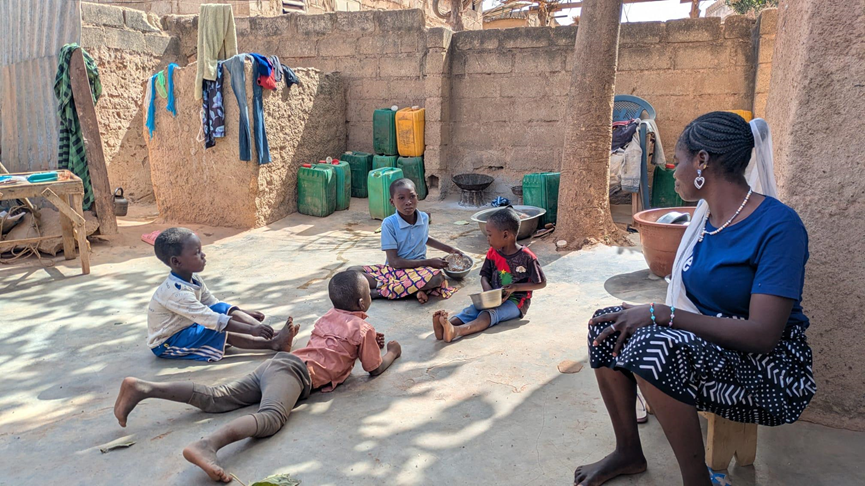
In many Burkinabe households, paying for medical care remains a major challenge, particularly among informal sector workers. This health-related precariousness leads not only to delays in care or to going without it, but also to a decline in income-generating activity and to the impoverishment of the family, which has to dip into its capital, sell assets or borrow to pay for treatment. A lack of knowledge (about the healthcare on offer and about health) and socio-cultural barriers (the weight of rumours, beliefs and stereotypes) also delay care. Moreover, the quality of health facilities (hygiene, availability of medicines, relationship between health workers and patients, etc.) is uneven, even though it is a decisive factor in access to care.
Sources:
- UNDP (2025). Human Development Report 2025: A matter of choice: People and possibilities in the age of AI. New York. https://hdr.undp.org/content/human-development-report-2025
- La Tribune (2026). En quête de 55 milliards d’euros pour son développement, le Burkina Faso peut compter sur son or (in French). https://www.latribune.fr/article/afrique/1092544436015514/en-quete-de-55-milliards-deuros-pour-son-developpement-le-burkina-faso-peut-compter-sur-son-or
- World Bank (2025). Note sur la situation économique du Burkina Faso : l’énergie au service de la croissance (in French). https://www.banquemondiale.org/fr/news/press-release/2025/07/10/burkina-faso-economic-update-energy-for-economic-growth
- World Bank (2026). Poverty and Inequality Platform. 2021 data. https://pip.worldbank.org/poverty-calculator
- National Institute of Statistics and Demography (INSD) (2025). Dynamique du marché de l’emploi au Burkina Faso (in French). https://www.insd.bf/fr/node/2177
LEARN MORE
about the programme and its results