

Where our partners work
- LAMESIN NYO — Health insurance, Lomé
- DUDENYO — Health professionals capacity building, Lomé
History of ATIA’s work in Togo
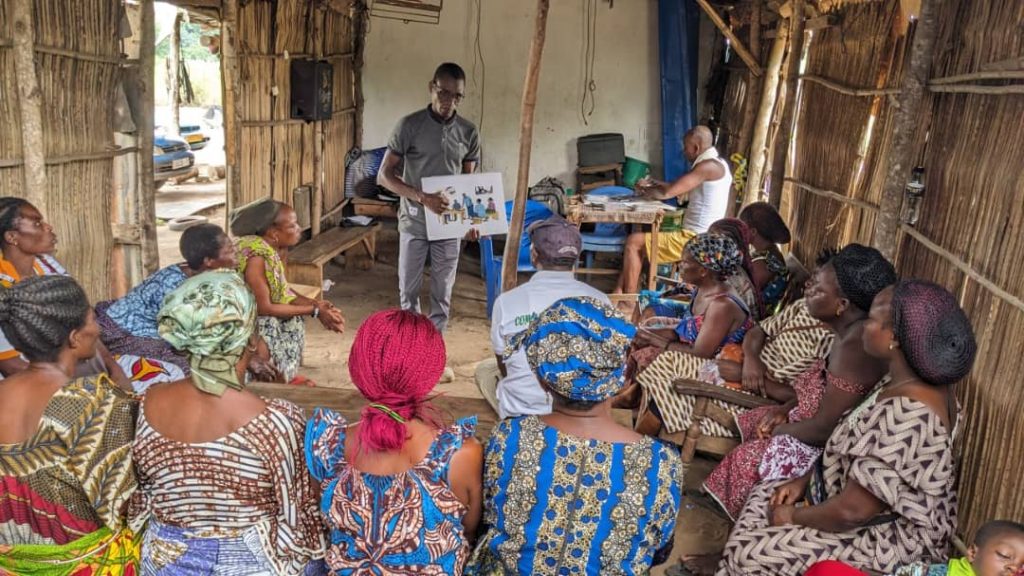
In 2023, ATIA supported the creation of the Togolese association LAMESIN NYO to provide social and health cover for informal sector workers in Lomé. The first reimbursements of care began in November of the same year.
LAMESIN NYO initially targeted the beneficiaries of the microfinance institution Assilassimé Solidarité and their families, in order to improve their use of healthcare in a lasting way and to secure their socio-economic situation. Today, LAMESIN NYO has widened its beneficiary base beyond the members of Assilassimé Solidarité alone (supported by the NGO Entrepreneurs du Monde), by forging new partnerships with other organised groups.
ATIA supports LAMESIN NYO in strengthening its governance, its network of healthcare providers and its operational capacity, with a view to gradual autonomy. The operational management of LAMESIN NYO, initially led by an ATIA expatriate, was transferred to a local director in 2025, marking a key step in this process.
Economic and health context in Togo
Togo is one of the least developed countries in the world, ranked 161st out of 193 on the Human Development Index (HDI 2023) (1). Its economy relies mainly on agriculture (notably cotton, coffee and cocoa), phosphate mining and the port of Lomé, which is a regional hub. Despite positive economic growth in recent years, poverty remains a major challenge, with around 44% of the population living below the poverty line (2). The informal sector plays a dominant role in the economy, with nearly 75% of the working population working without social protection (3).
Togo has a developing health system, but it still faces many challenges, notably limited access to care for vulnerable populations. Infectious diseases such as malaria, respiratory infections and waterborne diseases remain major causes of illness and death in the country.
In Togo, among informal sector workers, access to care remains limited and feeds a vicious circle between illness and poverty. Health expenses often lead people to go without care, fall into debt, sell assets or dip into the capital of their micro-businesses, which weakens family incomes. Delays in seeking care are also explained by a lack of information about the healthcare on offer, low levels of knowledge about preventive health and socio-cultural barriers (rumours, beliefs, stereotypes). The uneven quality of health facilities (hygiene, availability of medicines, relationship between health workers and patients) reduces trust in and use of services.
Analyses by the National Consultation Framework of Mutuals of Togo (Cadre National de Concertation de la Mutualité du Togo) and Louvain Coopération (2016-2021) show that social protection schemes are underdeveloped. Health insurance schemes suffer from weak governance, fragile technical management, a lack of qualified human resources and the absence of suitable management tools and information systems. In 2017, 27 active health insurance schemes covered 40,000 to 50,000 people, a penetration rate of under 1% for a population of 7.5 million; six of them have since ceased operating for lack of a sustainable economic model.
Sources:
- UNDP (2025). Human Development Report 2025: A matter of choice: People and possibilities in the age of AI. New York. https://hdr.undp.org/content/human-development-report-2025
- INSEED (2021). Présentation des résultats du dernier recensement général de la population et des données sur la pauvreté au Togo (in French). INSEED Togo. https://inseed.tg/presentation-des-resultats-du-dernier-recensement-general-de-la-population-et-des-donnees-sur-la-pauvrete-au-togo/
- CADERDT (2021). Note politique sur l’emploi au Togo (in French).
LEARN MORE
about the programme and its results