


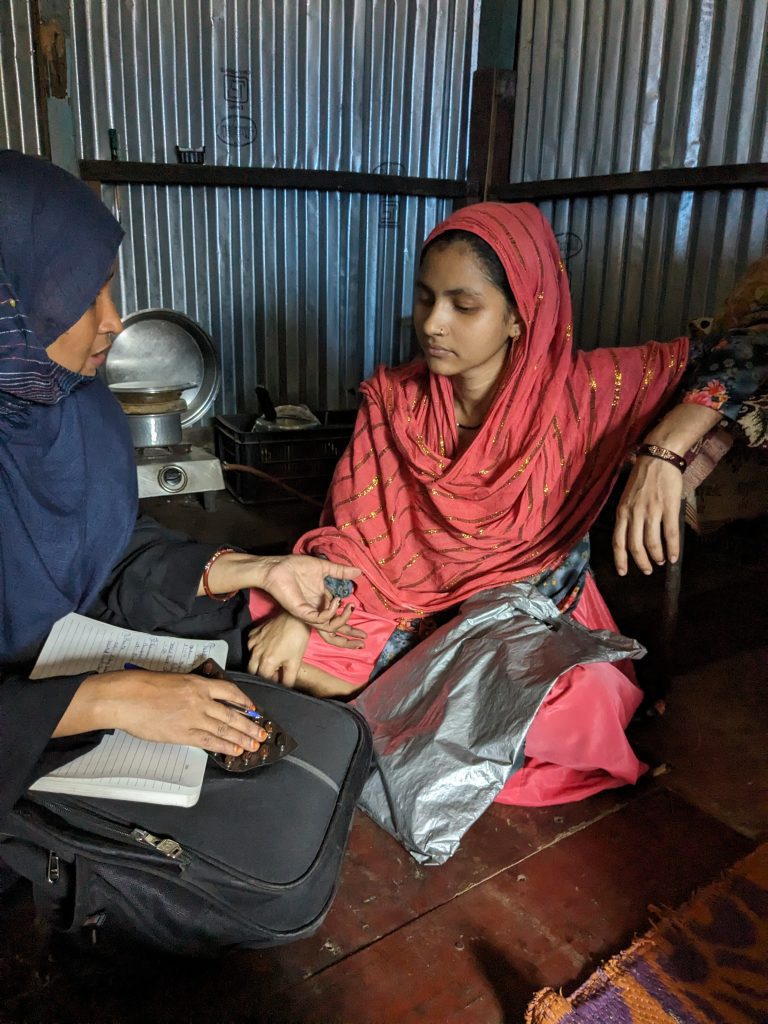
The “family snapshot”: a tool for measuring poverty in all its dimensions
Beneficiary families are selected using a social categorisation tool created by ATIA on the basis of the Multidimensional Poverty Index developed by the University of Oxford for the United Nations Development Programme, from which it takes ten shared criteria.
This tool, which ATIA calls the “family snapshot”, assesses a household’s level of poverty against 17 criteria across five dimensions: housing, education, health, economic situation and official documents.
The more deprivation a family faces on the criteria assessed, the lower its score and the closer the curve sits to the centre of the circle.
The “family snapshot” is measured when people join the programme, then at regular intervals (3 months, 6 months, and so on). It allows us to select families according to their level of poverty, then to measure the progress they make during the support period, and so to verify the impact of our work and whether that impact lasts.
What we are aiming at is not only better living conditions for the families we support, but more broadly their autonomy and their strengthened capacity to solve their own problems.
LEARN MORE
about the tool and the methodology
Example and analysis of a “family snapshot”:
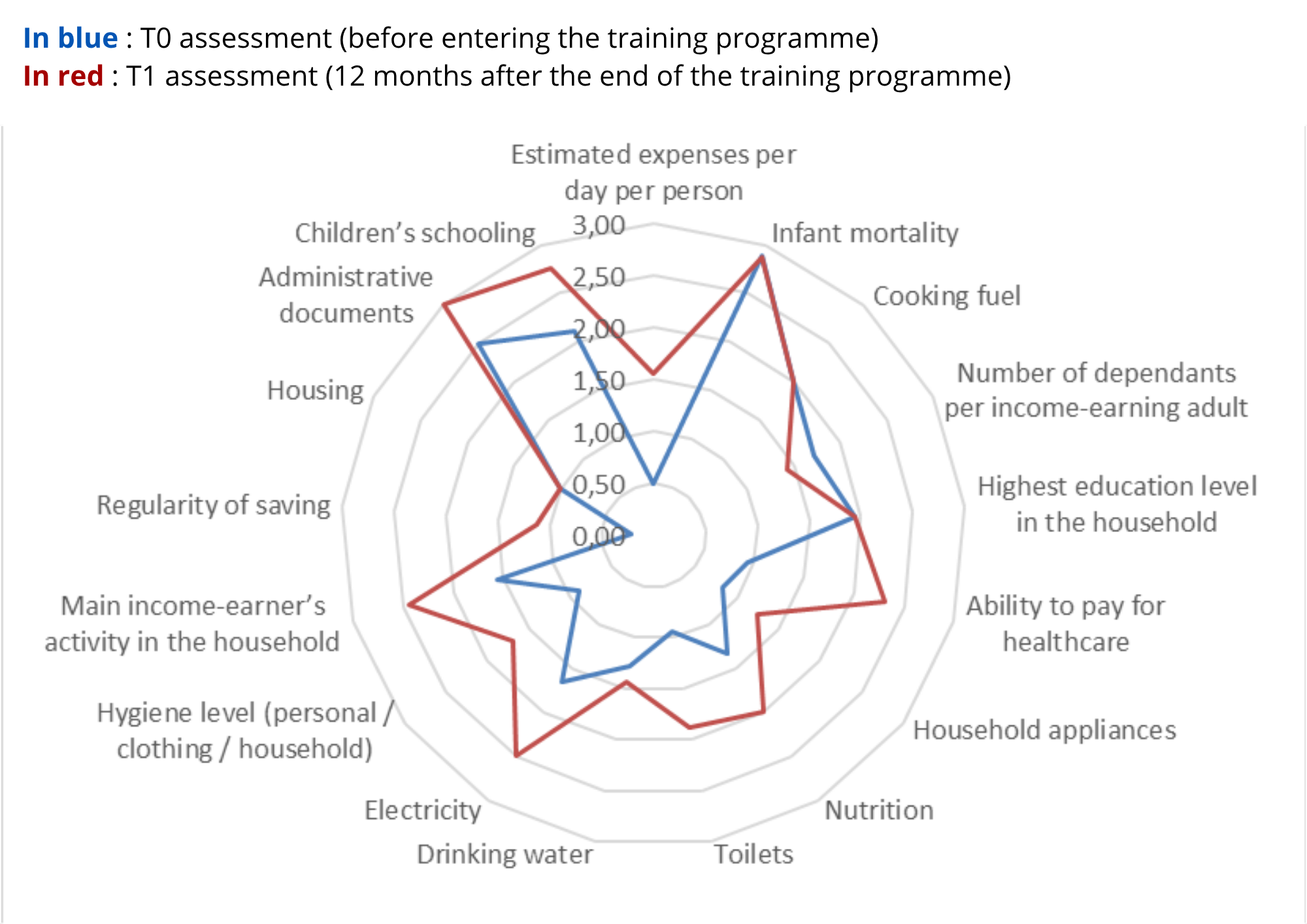
The chart above shows how the “family snapshot” changed for a cohort of sewing trainees who completed their training in 2023 at the TOHANA workshop and whose situation was reassessed in 2024.
Each item is scored from 0 (at the centre of the circle) to 3 points (at the outer edge). The blue line is the average of assessments carried out before the training; the red line is the average of assessments carried out 12 months after it ended.
There is clear progress in the areas the programme works on, notably:
- nutrition (+1)
- children’s schooling (+0.75)
- access to healthcare (+1.5)
- obtaining official documents (+0.5)
- household equipment — water, toilets, electricity (around +1)
- hygiene (+1.5)
- income (+1).
Overall, between the start of the training and the end of the support period (12 months after the training ended), this cohort’s score rose by an average of 8 points across all items.
The resilience scale
ATIA measures the resilience of the people it supports using the Connor-Davidson scale , which is statistically robust and already used in many countries. It has a good internal consistency index — meaning it measures the same thing each time — and good validity, meaning it genuinely measures a population’s degree of resilience.
It became clear that this scale was not easy for social workers to use in the field, as the questions are often abstract and hard to explain and to grasp for the people we support. In India, specific limitations were noted, linked to the linguistic complexity of the Hindi version, which made it less workable than in Madagascar. The local translations, in Hindi and Malagasy, have therefore been reworked to make the scale easier to adopt. Following the recommendations of the external evaluation of the social programmes, the question of whether to continue with or drop this tool in India is under review.
The empowerment scale
To analyse the situation of the women in its support programmes and track how their ability to make strategic choices evolves, ATIA has developed an “empowerment scale” drawing on several existing, scientifically validated scales. Hindi and Malagasy versions are used in the field, differing slightly by context and above all adapted to local realities.
ATIA’s empowerment scale assesses very concrete aspects of the situation and outlook of the women supported: 4 questions on mobility, 4 on decision-making within the family, 2 on financial autonomy, 1 on nutrition, 2 on physical domestic violence and 1 on the sharing of household tasks.
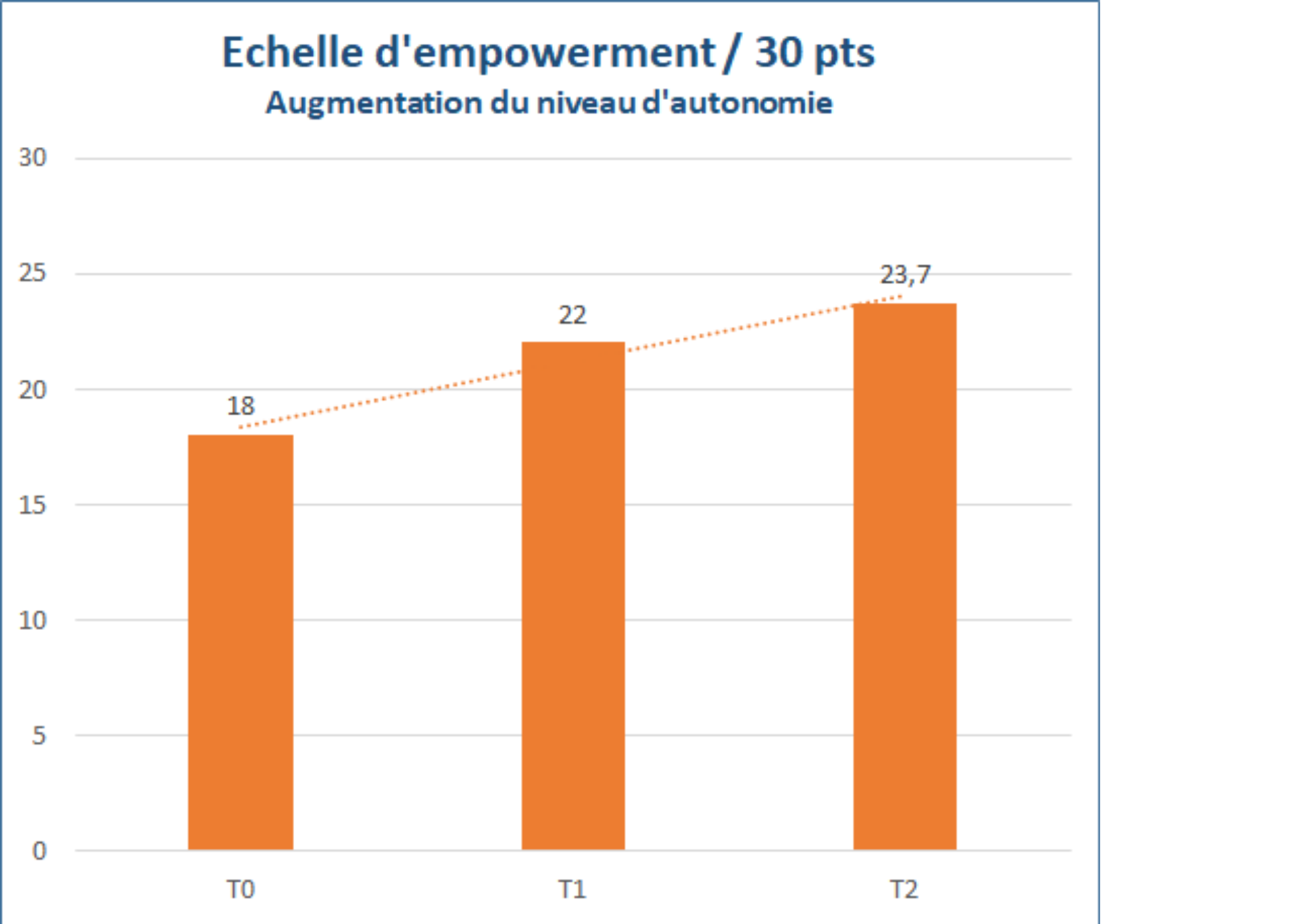
Level of autonomy among beneficiaries of the socio-economic inclusion programme in Madagascar and India on joining the programme (T0), on leaving it (T1, on average 7 months after starting) and 6 months after leaving (T2), for 4,257 families supported in 2024.
The grid of priority social goals
To help families improve their living conditions, ATIA created a grid of priority goals used by its partners. It allows us:
1/ to identify with the family the priorities to work on during the support period;
2/ to track the resolution of those goals by number and by theme, during and after the support period.
The grid contains 27 goals across 5 themes: health, childbirth, education, psychosocial and official documents. For each goal, the following are also gathered and analysed:
- the social worker’s observations and the identifiable indicators;
- the family’s wishes and the identification criteria;
- the resolution criteria.